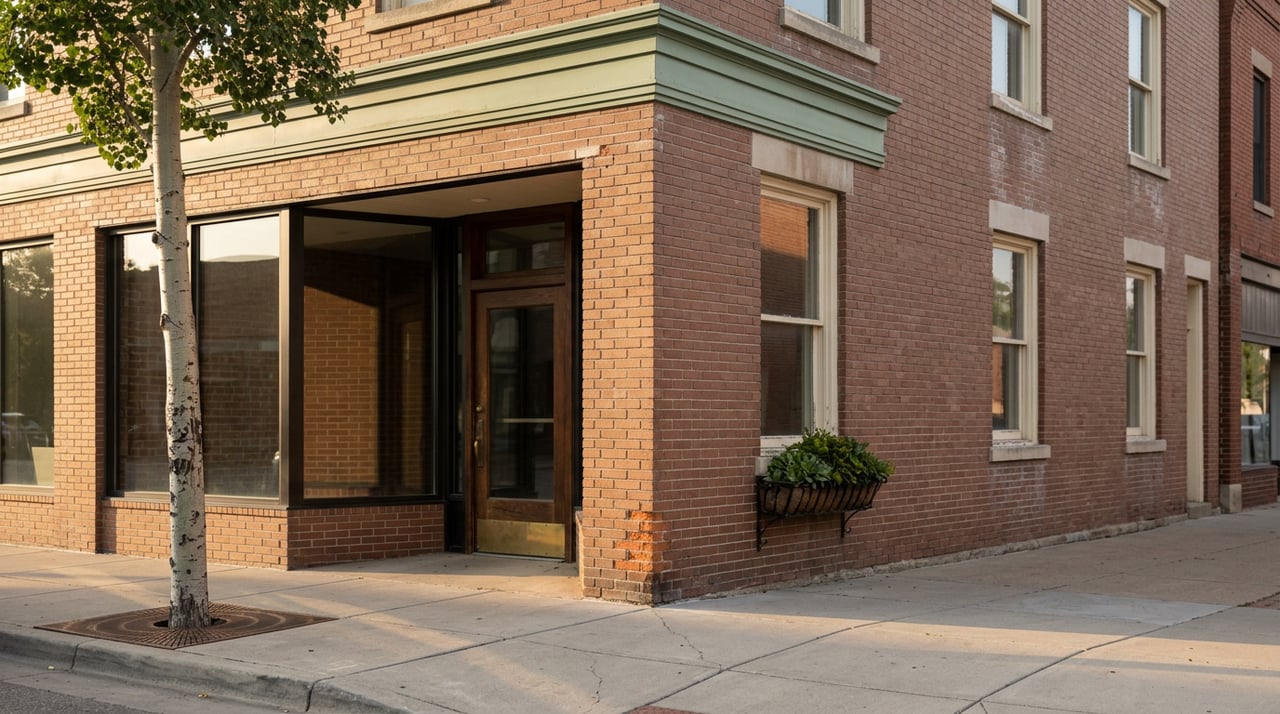
The Ward Hotel has sat at 925 Main Street since 1907, built by a state senator named Edward Donlan who wanted thirty sleeping rooms, a bar, and a basement power plant for the whole operation. It has changed hands more than once since then. Today its current owners, Daniel Moore and Marlaina Mohr, are working through a multi-year restoration that will bring it back to Main Street life under a new name, the Black Bear.
If you asked most buyers what it takes to touch a building like that, they would guess there is a historic commission somewhere reviewing paint colors and window trim. In Thompson Falls, that guess is wrong, and the gap between what people assume and what actually governs a historic property here is worth understanding before you write an offer.
The plaque doesn't do what people think it does
Thompson Falls has real historic weight. The Ward Hotel was listed on the National Register of Historic Places in 1986, the same year the city placed the Hydroelectric Dam Historic District on the register too. That district covers a specific set of structures: St. Luke's Hospital, Dr. Everett Peek's House, the Chief Operators' Houses, the Superintendent's House and Office, plus the Main Channel Dam, Dry Channel Dam, and the bridges connecting them across the Clark Fork.
Here's what that listing does not do. The North Carolina State Historic Preservation Office says a National Register listing, by itself, carries no obligation or restriction for a private owner spending private money on the property. Nobody requires you to restore anything to a certain standard, and nobody stops you from picking your own materials for a remodel. History Colorado says owners are not required to open the doors to visitors. A private owner only becomes bound by federal preservation standards if federal funding or a federal permit is part of the project, or if the owner applies for a benefit like a rehabilitation tax credit that comes with its own conditions attached.
That last part matters, because it means the restriction people worry about (a commission dictating your shutters) is usually a local zoning creation, not a federal one. Some towns layer a local historic district on top of the National Register listing, with its own review board and design guidelines. Thompson Falls has not done that. What governs a Main Street renovation here is the same document that governs everything else in town.
| What buyers usually assume | What's actually true in Thompson Falls |
|---|---|
| A historic commission reviews renovation plans | No separate historic design-review board exists here |
| The National Register listing restricts exterior changes | The federal listing is separate from local design review |
| Buying a historic building means special permitting | You work through the same city zoning ordinance as any other property |
| A tax credit is automatic once a building is listed | Credits apply only to income-producing rehabs |
The document that actually governs Main Street
The rulebook you want is the city's general Zoning Ordinance, currently Ordinance No. 358, last updated in July 2024 and available through the city's own ordinances page. It sets use categories, parking requirements, and what is and isn't permitted in the central business district that runs along Main Street. Marijuana sales, for example, are restricted to that same commercial corridor under the city's code, a detail that shows how specific this document gets about what can operate where.
The 2024 update is worth knowing about if you're looking at a historic building for anything beyond a personal residence. City council took up the ordinance rewrite in June 2024 partly because residents raised questions about short-term rentals and small hospitality uses. As reported by Valley Press, Zoning Committee member Mark Sheets said at the time that public input pushed the council to look closely at daycares along with "bed and breakfasts, house rentals." If your plan for a Main Street building involves a bed and breakfast, a short-term rental, or any adaptive reuse beyond single-family living, this is the ordinance that decides whether that use is permitted, not the historic listing on the building's file with the state.
Sanders County holds the legal descriptions and deed records for these properties at the courthouse in Thompson Falls, which is the place to confirm boundaries, easements, and any recorded conditions before closing. A title company or your agent can help pull that, but it's worth knowing the record exists independently of the National Register file.
If you want the tax credit, here's the catch
Historic buildings do come with a real financial upside, just not the one most buyers expect. A privately owned building listed in the National Register can qualify for a federal income tax credit equal to 20% of a qualified rehabilitation, and Montana adds a state credit worth 25% of whatever federal credit you claim. Stacked together, that is a meaningful offset against the cost of a serious rehab.
The catch is that this credit is built for income-producing property. It applies to rental, commercial, or other revenue-generating uses of a building, not to a straightforward owner-occupied home. If you're planning to run a business out of a Main Street storefront, rent out apartments above it, or otherwise generate income from the structure, the credit is worth a real conversation with a tax professional and the Montana State Historic Preservation Office, which administers the program at the state level. If you're buying a historic house purely to live in it, the credit likely doesn't apply to you, and that's fine. It just means the historic designation is a matter of pride and record, not a line item on your return.
What this means for the number on the sign
None of this changes what a property is worth on paper, but it should change how you read the number. As of August 2026, Thompson Falls listings carried a median asking price in the low $600,000s. A separate valuation model that tracks typical home value across the broader housing stock, last updated at the end of May 2026, put the average closer to $438,670, up about 2.8% over the prior year. Those two figures aren't contradicting each other so much as measuring different things: one reflects what sellers are currently asking, the other estimates typical value across every home in the market, including ones that aren't actively listed.
For a historic Main Street building, that gap matters more than usual. A century-old commercial structure with income potential and tax credit eligibility can carry a different math than a typical single-family home, and neither of those big headline numbers will tell you which bucket your specific building falls into. The zoning use, the building's condition, and whether a rehab budget qualifies for the credit will do more to set real value than any citywide average.
If you're weighing a historic building downtown against something along the Clark Fork instead, the two paths come with different homework. Waterfront property in Thompson Falls carries its own set of seasonal and access questions, which our guide to riverfront living in Thompson Falls covers in more detail.
A few questions worth asking before you tour
Does a historic listing affect my homeowners insurance? Not by default. According to Wisconsin Historical Society guidance, a listed property is treated like any other building for insurance purposes, and owners aren't required to carry policies that mandate historically accurate replacement materials.
What might lenders consider? Lenders will care about the same things they always do: condition, appraisal, and whether the building's current use matches the zoning on file.
What if I want to tear it down someday? According to Preserve Washington, the National Register listing alone does not prevent demolition of privately owned property. Local zoning could still come into play depending on the use and district, which is one more reason to read Ordinance 358 rather than assume the historic file settles the question.
Thompson Falls has more of its story sitting in plain sight on Main Street than most towns its size, and that's worth appreciating whether or not you ever apply for a tax credit. But the paperwork that will actually shape your ownership experience is the zoning code, not the plaque. If you're looking at a historic property here, whether it's a storefront, a house in the dam district, or something in between, Deborah Warren can walk you through what the zoning allows, what the county records show, and what the building is actually worth to you. Reach out for a local market consult before you make an offer.
This article is general information, not legal, tax or financial advice. Consult a qualified professional about your situation.