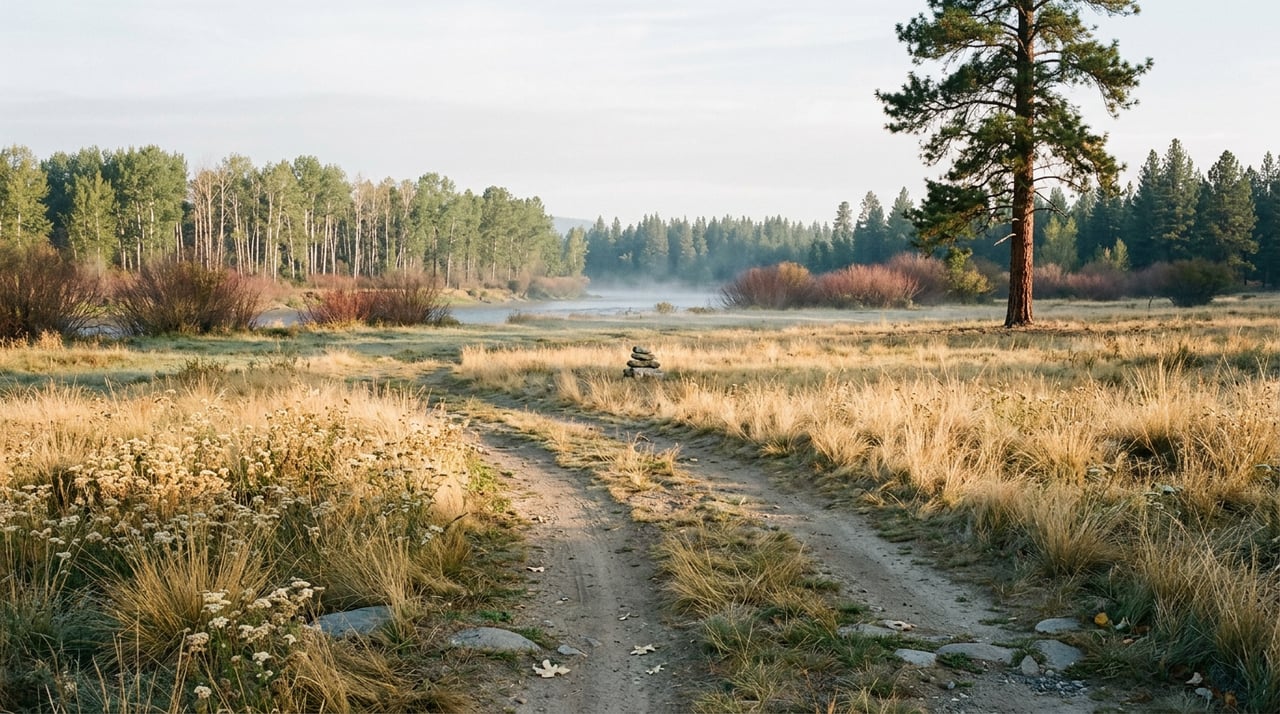
You close on five acres along the Clark Fork west of Plains. The listing photos showed empty water, morning mist, maybe an eagle if you were lucky. You imagined mornings with coffee on a bank that belonged to you and nobody else.
Then, sometime in your first summer, a drift boat floats past. The anglers wave. One of them wades up onto the gravel bar that sits below your property line and starts casting.
He is not trespassing. Under Montana law, he never was.
That is the part of buying riverfront near Plains that rarely makes it into the marketing copy, and it is worth understanding before you write an offer, not after you find out the hard way.
The river you're actually buying isn't one river
Clark Fork frontage near Plains is not a uniform product. The character of the water shifts noticeably depending on which stretch of bank you're standing on, and that shift affects what the property is actually good for.
Upstream of town, the float between Tarkio and Plains is one of the more scenic runs on this section of river. Through and just below Plains, there's a public boat launch that puts recreational traffic on the water right in town. About five miles downstream, the river picks up a short Class II rapid and a Class III drop before continuing on toward Thompson Falls, where a series of dams eventually stops floating altogether and turns the river into a chain of reservoirs.
Fishing quality tracks a similar pattern. Trout fishing on this stretch falls off noticeably as you move downstream of Plains, while pike become a bigger part of the catch. If the reason you're paying a premium for riverfront is dry-fly fishing off your own bank, a parcel five miles below town is a different product than one closer in, even though both listings will say "Clark Fork frontage."
| Stretch relative to Plains | Recreational character |
|---|---|
| Upstream (toward Tarkio) | Popular scenic float |
| At Plains | Public boat launch, in-town access |
| 5 miles downstream | Class II/III rapid, floating gets technical |
| Further downstream | Trout quality drops, pike fishing improves |
None of this shows up in a acreage figure or a price per foot of frontage. It shows up when you actually look at where on the river the pin drops.
"Riverfront" doesn't mean the river is yours
This is the part that catches out-of-state buyers most often. Montana's Stream Access Law, passed by the legislature in 1985 after the state supreme court's 1984 ruling in Montana Coalition for Stream Access v. Curran, gives the public the right to use any river or stream capable of recreational use up to the ordinary high-water mark, regardless of who owns the land underneath or alongside it. Fish, Wildlife and Parks puts it plainly: recreationists can wade, float, fish, and swim in that water even where the streambed itself is private property.
What the law does not do is give anyone a right to cross your dry land to get to the water. If your property is posted and there's no public bridge or easement nearby, someone still needs your permission to walk across your yard to reach the river. But once they're in the water, between the banks, up to that high-water line, they're on legal ground the moment their boots get wet.
So when a listing near Plains uses the word "private" next to "riverfront," it usually means private land, not private water. The distinction matters if part of what you're paying for is solitude on the river itself rather than just a nice view of it from your porch.
The other thing riverfront doesn't automatically include: the water
Owning the bank is one legal question. Having the right to actually use the water for irrigation, livestock, or a lawn is a separate one, administered by the state through the Department of Natural Resources and Conservation.
Montana water rights are generally appurtenant, meaning they're tied to the land and travel with it in an ordinary sale. But "generally" is doing real work in that sentence. A seller can sever the water right and keep it, or split it between parcels, and if that happens the transaction needs different paperwork than a standard sale. The state's Realty Transfer Certificate requires a specific water rights disclosure section for exactly this reason, and depending on what's checked, the seller and buyer may need to file a DNRC ownership update, a divided-interest form, or a severed-rights form before the deal is truly finished on paper.
Buyers sometimes assume that because a property has always had water, whoever owns the property gets the water. In Montana, the water right and the land are two separate legal records, and only one of the two automatically shows up on the county deed.
Even when everything is done correctly, there's a lag. One account from a water rights attorney describes DNRC's processing time for these ownership updates as commonly running three months or longer after closing, even though the transfer itself takes legal effect on the day the deed is signed. Your name is the owner of record at the courthouse well before your name is the owner of record with the state's water rights office.
There's a further wrinkle for anyone planning to actually put more water to use than the previous owner did. Montana operates on a prior appropriation system: whoever first put water to beneficial use on a given source holds the senior claim, and that priority date decides who gets water first in a shortage. A water rights guide published through Montana State University Extension notes that historic use, not just the acreage listed on paper, is what actually gets tested if a dispute arises. Buyer's guides on this subject describe cases where a new owner assumed the acreage written on an old water right matched what had actually been irrigated for decades, started expanding use accordingly, and ran straight into objections from downstream users who depended on that same water. The dispute ended up in front of a judge, and the paperwork alone wasn't enough to win it.
What this means if you're actually looking near Plains
None of this should scare a buyer off Clark Fork acreage. It should change what you check before you write an offer.
Ask where, specifically, the parcel sits relative to Plains, and whether that stretch matches what you actually want to do on the water. A quiet stretch for kayaking is not the same purchase as a stretch known for trout.
Ask whether the listing specifically states that water rights are included, and if so, get the water right number and pull it yourself through the state's Water Rights Query System. Some Plains-area land listings call out included water rights explicitly. Others don't mention them at all. That's not an oversight. It's a difference in what you're actually being offered.
Confirm at closing that the Realty Transfer Certificate's water rights section is filled out completely and that any required DNRC ownership update gets filed, not just discussed. The Realty Transfer Certificate itself lays out which additional forms apply depending on whether the right is being sold whole, split, or kept back by the seller.
And understand, before you ever picture your first summer on the bank, that the water in front of your new property is doing double duty. It's yours to look at, and legally, it belongs to whoever else Montana law says gets to use it too.
FAQ
Does the Stream Access Law mean anyone can walk across my yard to get to the river? No. The law covers use of the water itself between the high-water marks. Crossing dry, posted private land still requires permission unless there's a public bridge, easement, or unposted access point.
If I buy riverfront property, do I automatically get the water right that goes with it? Usually, but not automatically in the sense of requiring no paperwork. Water rights are generally appurtenant to the land, but the transfer still needs to be reflected in the Realty Transfer Certificate and processed by DNRC, and a seller can legally sever or divide the right from the land at sale.
Does the river behave the same way at every point near Plains? No. The float character, boat traffic, and fish species all shift noticeably within a few miles, upstream versus downstream of town.
If you're weighing a specific stretch of Clark Fork frontage near Plains and want to talk through what the parcel's location actually gets you, Deborah Warren has spent decades working this corridor and can help you read a listing for what it really means before you make an offer.